South Korea · City guide

Seoul

Seoul’s international schools sit at an unusual crossroads: a century-old heritage sector built for foreign residents, now sharing a market with Korean families hungry for an English-medium education — under rules that strictly gate who may attend. Fees rival Shanghai’s, bills arrive split between won and dollars, and the map has quietly shifted south and west.

The landscape

A heritage sector with official data — and a new customer

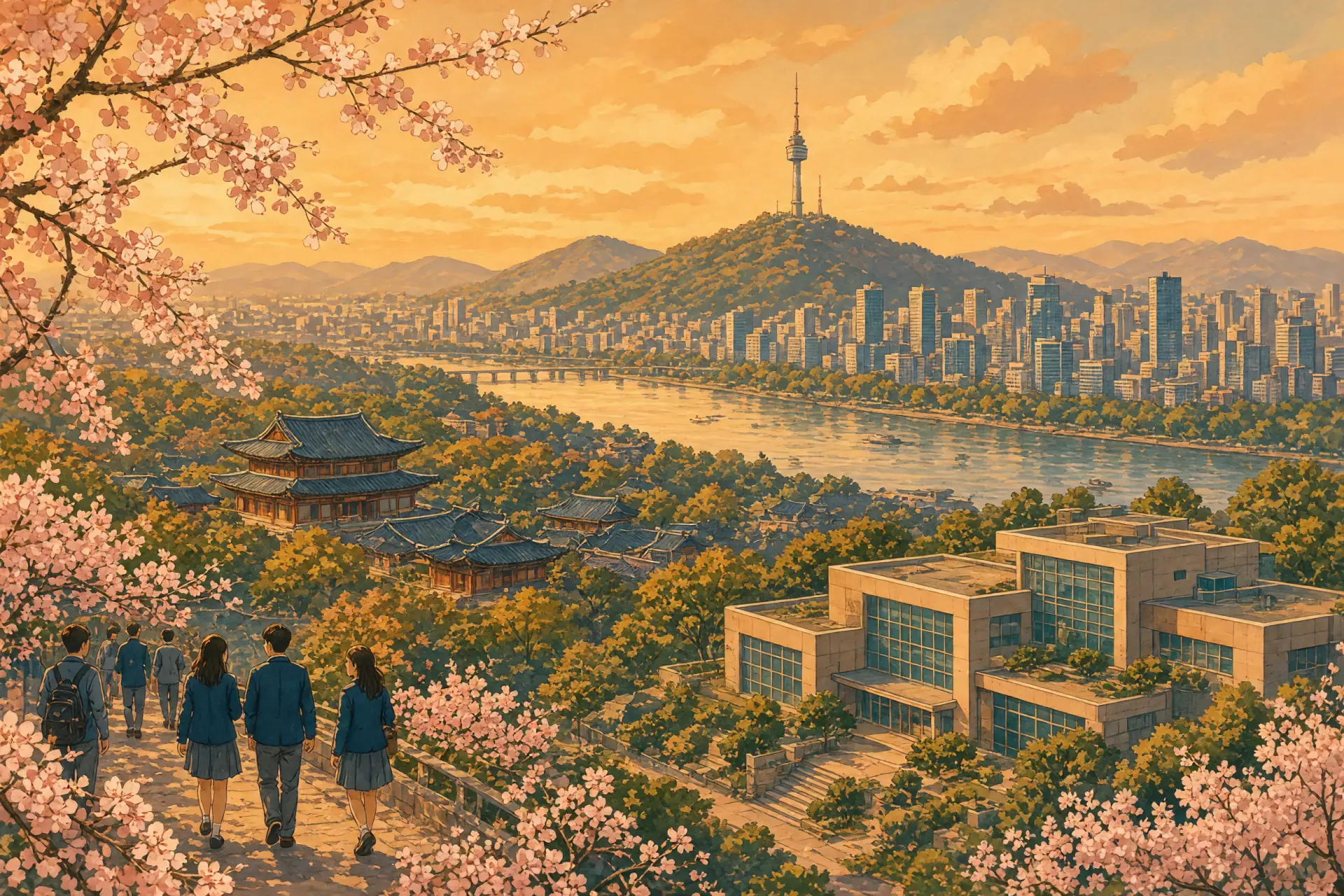
Illustration of Seoul's Namsan tower and Han river skyline with an international school campus in the foreground

Korea has roughly 60 foreign schools, 15 of them in Seoul. The Seoul Metropolitan Office of Education publishes enrolment and fee data, which makes this a refreshingly documentable market. As of September 2024: Seoul Foreign School is the giant at 1,958 students (USD 40,990-49,610 a year); YISS follows at 1,010 (USD 27,230-31,805); Korea International School’s Seoul campus at 975; Asia Pacific International School at 800; Dulwich College Seoul at 700 (USD 38,690-40,370); and Dwight School Seoul at 620 (USD 29,064-34,249).

Seoul Foreign School anchors the sector. Founded in 1912 by American missionaries, it is Korea’s oldest international school and one of Asia’s oldest — a full IB and English National Curriculum operator in Yeonhui-dong, beside the Yonsei University area in western Seoul.

The demand story has changed, though. Much of the growth energy in Korean international education now comes from Korean families themselves — seeking an English-medium alternative to the domestic exam track without sending children abroad early. That demand is channelled by strict eligibility rules, and it explains two of this market’s oddest features: Songdo and Jeju. More on both below.

The rules

Who is legally allowed to attend

Mainland foreign schools exist to educate foreign residents. The standard admission conditions: the child holds a foreign passport, at least one parent is a foreign national, and the child passes the school’s assessment and interview. Korean-national children qualify only if they have lived overseas for three or more years — and schools’ Korean-national intake is capped by regulation (30 per cent, with limited headroom above that).

Jeju Global Education City is the deliberate exception. Schools inside the Jeju Free International City zone — North London Collegiate School Jeju, Branksome Hall Asia, St. Johnsbury Academy Jeju, KIS Jeju — may enrol Korean nationals up to 100 per cent of seats with no overseas-residence requirement, and their qualifications are recognised domestically. The result is a boarding-school island built substantially for Korean families: early reporting put NLCS Jeju’s student body at 98 per cent Korean. For an expat family posted to Seoul, Jeju is a boarding option, not a local one — but it explains why Korea’s premium British-school brands are on an island rather than in the capital.

Songdo is the middle case. Chadwick International, in Incheon’s purpose-built Songdo district, was founded in 2010 under rules that let “international schools” in free-economic zones enrol Korean nationals within quota — which is why a nominally expat school an hour from Seoul has long drawn a majority-Korean applicant pool. Check the current mix with admissions if peer-group composition matters to you.

Named schools

Real fees — and the split won/dollar bill

A Seoul quirk first: several top schools split tuition into a Korean-won portion and a US-dollar portion, so your bill moves with the exchange rate. Figures below are 2026-27 aggregated published prices unless noted — confirm the current schedule and the currency split with each school.

  • Seoul Foreign School (Yeonhui-dong; IB + British): ₩40.2-56.2 million per year, plus a ₩400,000 application fee, ₩650,000 registration and a ₩5.5 million entrance fee.
  • Yongsan International School of Seoul (Itaewon-ro, American/Christian, AP): ₩32.5-38.0 million, plus ₩500,000 application, ₩1,000,000 registration and a ₩4.5 million new-student capital development fee.
  • Dulwich College Seoul (British + IB): ₩42.7-47.9 million. Korea International School (Pangyo, American + IB Diploma): ₩34.2-46.8 million. Dwight School Seoul — the first full IB continuum school authorised in Seoul: ₩28.1-36.4 million.
  • Chadwick International (Songdo): ₩56.4-65.8 million for 2026-27 — the market’s price ceiling. Foreign-passport holders may apply throughout the year.
  • Seoul International School (Seongnam, founded 1973, American/AP): secondary compilations put fees around ₩30-43 million — we have not verified a first-party schedule, so treat this as indicative.
  • The national schools: Deutsche Schule Seoul International (USD 18,200-25,200) and the Lycée Français de Séoul (USD 8,834-13,510) per the Seoul Metropolitan Office of Education table — the French lycée is remarkable value by this market’s standards.

A budget tier exists too — small Christian and community schools at ₩8-16 million a year — but check accreditation and teacher stability carefully at that end of the market.

Geography

Three clusters and an island

Yongsan/Itaewon/Hannam is the historic expat core: YISS sits on Itaewon-ro and the Deutsche Schule in Hannam-dong, walkable from the international neighbourhoods that grew up beside the old US garrison. Seongnam, Bundang and Pangyo, south of the river, hold SIS and KIS Pangyo — modern campuses serving the technology-corridor communities, with school buses running back into Seoul. Songdo, an hour west in Incheon, is Chadwick’s purpose-built smart-city world: families who choose it usually commit to living there, not commuting from Seoul.

And then there is Jeju — a separate decision entirely. If a Seoul posting comes with a desire for British boarding education, NLCS Jeju or Branksome Hall Asia can make sense; parents describe the weekly-flight rhythm as workable but real. Treat Jeju Global Education City as its own market, with its own logic, rather than as part of a Seoul shortlist.

The military factor

What the move to Camp Humphreys changed

For decades, the US military community in Yongsan was part of Seoul’s international-school ecosystem. That ended with the Yongsan Relocation Plan: US Forces Korea moved its headquarters to Camp Humphreys in Pyeongtaek in 2018, more than 20,000 troops and family members followed by the end of 2019, and the DoDEA’s Seoul American High School — open since 1959, over 1,000 students at its peak — closed in 2019 with just 146 students in its final year.

The practical read for a civilian expat family: the Itaewon area has been re-inventing itself since the garrison wound down, the English-speaking service economy around it is thinner than a decade ago, and military families themselves now live an hour-plus south around Pyeongtaek, where Camp Humphreys runs its own DoDEA schools. If your posting is military-affiliated, Seoul’s civilian international schools are a backup plan, not the default.

Admissions

Calendars, mid-year entry, and ground truth

The year starts in August. The premium schools run formal cycles — Chadwick’s main window has historically run from early November to late January for the following August — with assessments ranging from observed play sessions in early years to reading, maths and written-English testing from Grade 3 up. Apply from overseas; interviews and assessments can usually be arranged remotely or on a visit.

Mid-year entry exists, especially for foreign-passport holders — Chadwick explicitly accepts such applications year-round, and corporate churn opens seats across the market. Expect application fees of ₩400,000-500,000 per school, registration and capital or entrance fees of ₩4.5-5.5 million at the premium schools on acceptance, and first-year costs well above the tuition line.

From the parent channels (r/korea, expat Facebook groups) — reported experience, not verified fact: check the currency split before signing (a weak won makes the dollar portion of tuition hurt); ask about the Korean-national share of the student body if an internationally mixed peer group is the point; and model the bus commute — Bundang and Pangyo campuses run long routes into Seoul, and parents split on whether the campus quality justifies the ride for young children.

Sources

Where the numbers on this page come from

Every fee figure traces to our research dossier. Primary sources: the Seoul Metropolitan Government foreign-schools table (Seoul Metropolitan Office of Education data), KOTRA’s foreign-school guidance, and the Jeju GEC regulatory comparison. School-level fees are from aggregated 2026-27 published prices (International Schools Database) — graded medium confidence in the dossier — and should be confirmed against each school’s own schedule, particularly the won/dollar split.

Fees and policies expire. This page was researched on 2 September 2026 and is re-verified each academic year — see our research standard, the school directory, the guides hub and corrections if you spot something stale.

Coverage priorities

What we investigate here

01

The landscape: official enrolment and fee data for Seoul’s foreign schools — and who the schools are really for now.

02

The eligibility rules: foreign-passport admissions, the three-year overseas rule for Korean nationals, and the Jeju exception.

03

Named schools with real numbers: SFS, YISS, Dulwich, KIS, Dwight, SIS and Chadwick — published KRW fees with sources.

04

The geography: Yongsan/Itaewon, Seongnam/Bundang/Pangyo, Songdo — and Jeju Global Education City as a separate phenomenon.

05

The US military factor: how the Yongsan-to-Humphreys relocation reshaped the expat school map.

06

Admissions: calendars, mid-year entry, and the dual-currency bill.

Research in progress

We publish clusters, not placeholders.

This city opens in full when its first connected group of school profiles, fee explainers, and admissions guidance has passed our evidence and editorial gates.

Read our publication standard →