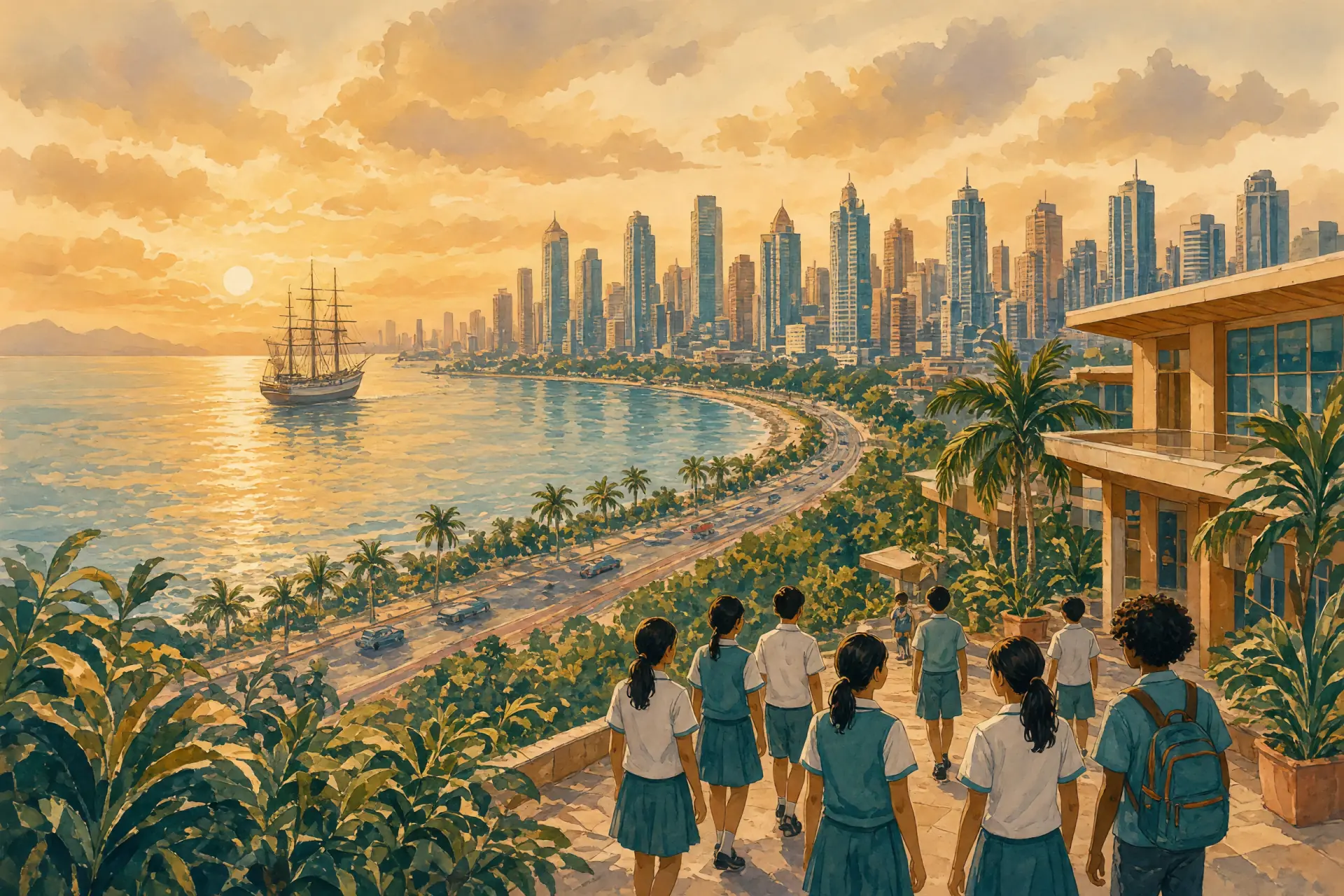
Panama City’s school market exists because of its economy. The canal, the Colón Free Zone and a dollarised banking centre have made the city Latin America’s default regional-headquarters location: relocation-industry counts put the number of multinational regional HQs at well over a hundred, clustered along the Costa del Este corridor and in Panama Pacífico, with names like Procter & Gamble, Adidas, Nestlé and Huawei rotating staff through on two-to-four-year postings. Those families are the core of international-school demand. ↗
Everything is priced in dollars. Panama uses the US dollar as its circulating currency (the balboa exists only as coins, pegged 1:1), so every fee figure on this page is in USD and carries no exchange-rate risk — a genuine difference from postings in Mexico City or São Paulo. More than 20 international or bilingual campuses operate in the capital, with tuition roughly $8,500-28,000 a year at the international tier. ↗
The market has three tiers, and they are not interchangeable. The international schools (ISP, MET, King’s, Balboa Academy and peers) teach foreign curricula in English on an August–June year. A large bilingual private sector teaches the Panamanian curriculum with strong English hours for a fraction of the price — St. George International publishes $3,550-4,320 a year, and AIP Academia Interamericana in Costa del Este charges $625-850 a month — but on the local March–December calendar. And the public system, free and Spanish-medium, is rarely practical for a child arriving without Spanish. Most relocating families land in tier one; some long-stay families deliberately choose tier two for immersion. ↗
One caveat on the expat story: much of Panama’s foreign-resident growth is retirees on the pensionado programme and remote workers, not families. That wave moves the housing market and the service economy; it does not fill school seats. The schools live and die by the corporate postings.